In the Long Run We Are All Dead: Keynesianism, Political Economy, and Revolution by Geoff Mann
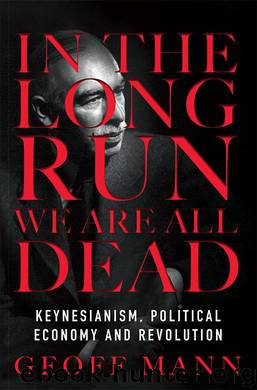
Author:Geoff Mann [Mann, Geoff]
Language: eng
Format: epub
Publisher: Verso Books
Published: 2017-01-24T00:00:00+00:00
The Fetish of Liquidity
This is why liquidity—the ability to readily buy or sell an asset at a relatively small transactions cost—is so crucial to Keynes’s conceptual structure. He focuses on investment, which he considers the engine room of capitalism, arguing that an obsession with “the anticipation of impending changes” is an “inevitable result” of capitalist “investment markets organised with a view to so-called ‘liquidity”’—in other words, organized with a view to holding one’s wealth in money or near-money form. In the realm of investment, changing preferences for liquidity are the most important effect of ineradicable, individualized, self-interested uncertainty in the economic “region” of modern social life:
Of the maxims of orthodox finance none, surely, is more antisocial than the fetish of liquidity, the doctrine that it is a positive virtue on the part of investment institutions to concentrate their resources upon the holding of “liquid” securities. It forgets that there is no such thing as liquidity of investment for the community as a whole. The social object of skilled investment should be to defeat the dark forces of time and ignorance which envelop our future.12
The political core of Keynesianism, and its importance in Keynes’s time and our own, lies here, in the centrality of this mode of analysis to modern politics. It describes liberal capitalism as simultaneously a virtuous circle of wealth production and as a vicious circle of political and social disintegration. The “fetish of liquidity”—the product of a deadly combination of fear and opportunism in a capitalist monetary economy—leads inexorably to hair-trigger obsession with “anticipating impending changes.”13 Unsurprisingly, this generates those changes and in particularly volatile form. Money and moneylike assets make a more or less liquid position not only easy to realize but imperative for any single potential investor, leading to a communitywide prisoners’ dilemma. Each individual, in search of a means through which to make the best of the uncertainty for himself or herself, makes the non-cooperative choice, for “there is no such thing as liquidity of investment for the community as a whole.” Driven by what Keynes called the “precautionary” and “speculative” motives to liquidity, money holders act directly against the “social interest,” feeding off and intensifying the very “dark forces of time and ignorance which envelop our future,” forces we should instead be focused on defeating:14
The actual, private object of most skilled investment to-day is “to beat the gun,” as the Americans so well express it, to outwit the crowd, and to pass the bad, or depreciating, half-crown to the other fellow … There is no clear evidence from experience that the investment policy which is socially advantageous coincides with that which is most profitable. It needs more intelligence to defeat the forces of time and our ignorance of the future than to beat the gun.15
Keynes—quite reasonably, it seems to me—thinks the classical position on liquidity preference is ridiculous. The idea that Say’s Law means that not spending is as good for effective demand as consumption is “absurd, though almost universal.” This “fallacy” persists despite
Download
This site does not store any files on its server. We only index and link to content provided by other sites. Please contact the content providers to delete copyright contents if any and email us, we'll remove relevant links or contents immediately.
| Anthropology | Archaeology |
| Philosophy | Politics & Government |
| Social Sciences | Sociology |
| Women's Studies |
The Secret History by Donna Tartt(18993)
The Social Justice Warrior Handbook by Lisa De Pasquale(12175)
Thirteen Reasons Why by Jay Asher(8870)
This Is How You Lose Her by Junot Diaz(6854)
Weapons of Math Destruction by Cathy O'Neil(6243)
Zero to One by Peter Thiel(5759)
Beartown by Fredrik Backman(5706)
The Myth of the Strong Leader by Archie Brown(5479)
The Fire Next Time by James Baldwin(5408)
How Democracies Die by Steven Levitsky & Daniel Ziblatt(5196)
Promise Me, Dad by Joe Biden(5127)
Stone's Rules by Roger Stone(5065)
A Higher Loyalty: Truth, Lies, and Leadership by James Comey(4937)
100 Deadly Skills by Clint Emerson(4898)
Rise and Kill First by Ronen Bergman(4756)
Secrecy World by Jake Bernstein(4724)
The David Icke Guide to the Global Conspiracy (and how to end it) by David Icke(4677)
The Farm by Tom Rob Smith(4484)
The Doomsday Machine by Daniel Ellsberg(4472)
